 $HAMSTER
Six decimals. All of it enters the program vault at launch.
SINGLE-USE LAUNCHPAD · SOLANA
Hamsterpad
One coin. One curve. One permanent pool.
Hamsterpad takes the complete $HAMSTER supply, sells 80% along its own curve, then moves every net SOL raised and the remaining 20% into Raydium at the same closing price.
Solana · Checking contract
Trade $HAMSTER
Reading Hamsterpad
Checking the curve account on Solana.
Curve progress—
$2K starting FDV$50K graduation FDV
hamster$HAMSTER
No trades yet. The first one shows up here as it lands.
PROGRAM BUILD ID
OFFICIAL MINT
Set at initialization
OFFICIAL RAYDIUM POOL
Created at graduation
Dollar values use the contract’s fixed $70.60/SOL reference and are illustrative. The program settles in lamports and does not use an oracle.
READ FROM SOLANA ON EVERY VISIT
Check the launch yourself.
These are the things a careful buyer would look up before trusting any launch.
For the full report, including a byte-for-byte comparison of the deployed program with your own build, run npm run status from the program’s repository.
Nobody can change the code
Reading the program.
The launch is in the state the program left it in
Reading the mint and the vault.
The code deployed now is the code that set up the curve
Nothing to check until the curve is launched.
Fees go to one fixed wallet
Reading the curve.
What the Raydium pool will charge
Reading Raydium’s fee config.
THE ACTUAL V3 CONTRACT
106 automated tests
Hamsternomics
536,336,552,336 tokens are available before graduation.
134,084,138,084 tokens pair with the curve proceeds.
Buyers supply every lamport of opening liquidity.
FDV at the fixed $70.60/SOL reference.
141.64305949 SOL plus 20% of supply, each worth $10K at the reference.
One uninterrupted price.
Bond
The marginal price blends 27/32 constant-product pricing with 5/32 linear pricing. It starts at $2K FDV.
Graduate
At exactly 80% sold, the curve has collected 141.64305949 SOL net and reaches $50K FDV.
Migrate
Anyone can create the official Raydium CPMM pool. It opens at the curve’s closing reserve ratio one second later.
Lock
The Raydium LP tokens are burned permanently. No underlying $HAMSTER is burned.
THE FINE PRINT, WITHOUT THE HEADACHE
Simple rules. On-chain guarantees.
Are fees paid in SOL or $HAMSTER?
All project fees are paid in SOL. Curve trades carry a 1% fee, and no $HAMSTER tokens are taken as fees.
How does Hamsterpad encourage a fair launch?
During the bonding phase, the curve enforces a 2.5% maximum holding for each buying token account, helping keep early distribution broad. The limit is per token account, not per person. The one exception is a buy the creator may make inside the launch transaction itself; if there was one, its size is shown under “Check the launch yourself”.
What happens when the curve graduates?
At 80% sold, the remaining 20% of supply and all net SOL raised move into the official Raydium pool at the curve’s closing price. The LP tokens are then burned permanently.
What if migration takes longer than expected?
Hamsterpad includes a built-in safety valve. If migration has not completed after three days, curve selling reopens so holders are never left without an exit path.
What happens to post-launch fees?
The Raydium pool is configured for a current 1% total fee. The project’s creator-fee share is collected in SOL and routed to the designated project fee wallet.
How has the launchpad been tested?
The v3 codebase includes 106 automated tests, full launch-to-Raydium lifecycle testing and regression coverage for every issue identified during its technical review.
PROJECT TREASURY
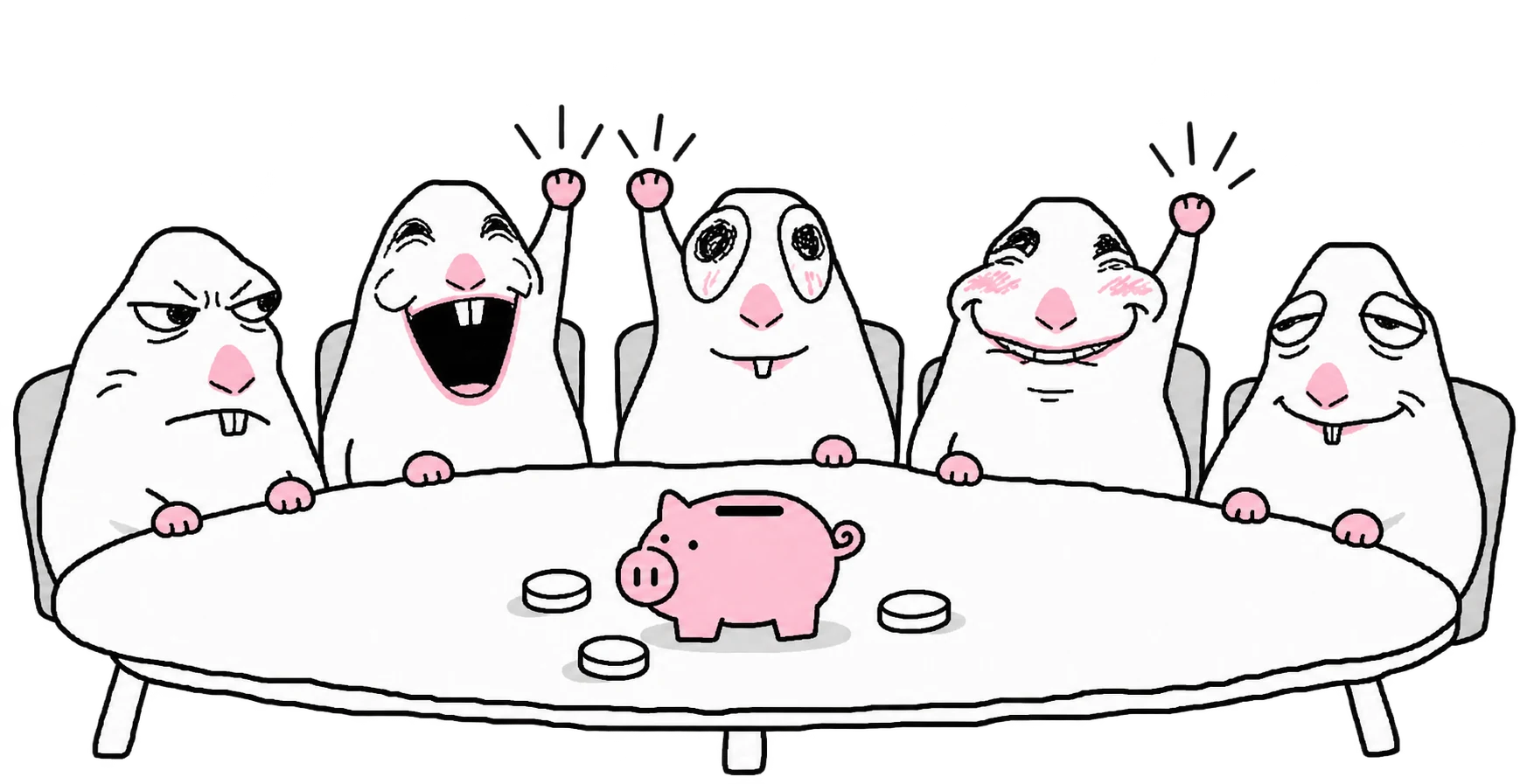
Three paws carry the vote.
The designated project fee wallet is planned as a five-member multisig requiring three approvals. Each board member must remain meaningfully aligned with $HAMSTER, and replacements require unanimous approval from the remaining members.
Of the project’s fee revenue, 80% is reserved for growth—including marketing, exchange listings and long-term operations—while 20% is distributed equally among the five active board members.